Milestones Matter: How the Nervous System Drives Development in Babies
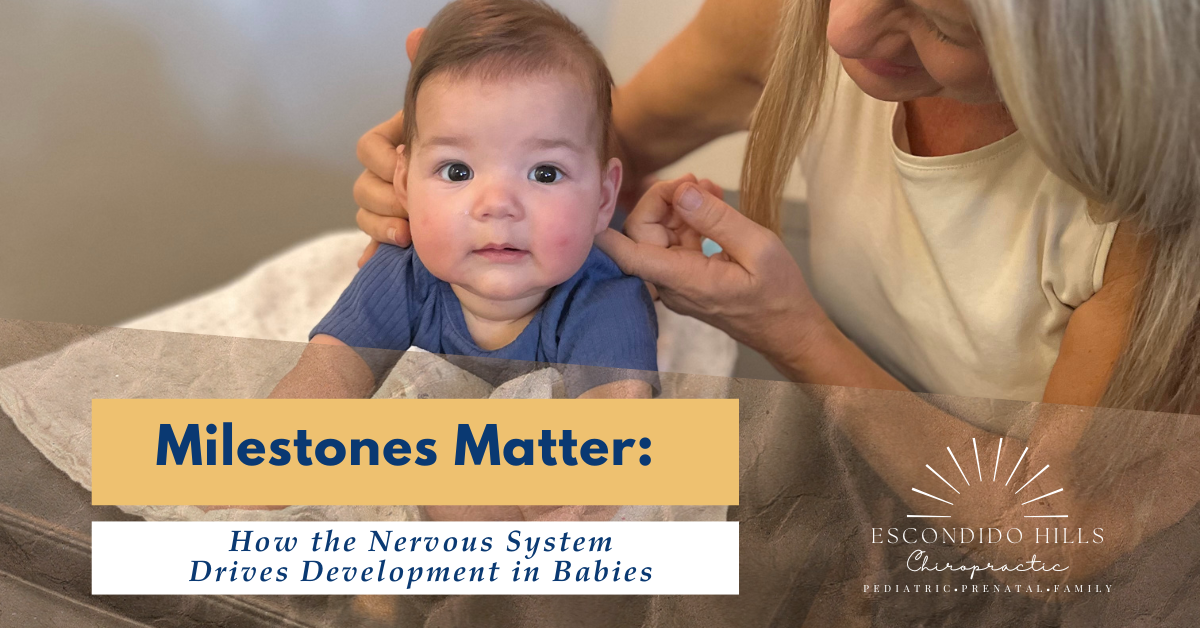
As parents, it’s exciting to watch your baby reach new milestones: the first smile, the first roll. And our favorite, the first time they crawl across the room at lightning speed to grab something they definitely shouldn’t have.
These developmental milestones are often celebrated as physical achievements, but there’s much more happening beneath the surface. Every milestone is actually a reflection of something even more important: the growth and development of your baby’s nervous system.
Rolling, crawling, sitting, and walking aren’t just signs that muscles are getting stronger—they’re signs that the brain and body are learning to communicate effectively.
Development Starts in the Nervous System
Your baby’s nervous system serves as their body’s master control center. From the moment they’re born, their brain and nervous system are gathering information, building connections, and coordinating movement.
Before a baby can roll over, their brain must learn how to coordinate both sides of the body. Before they can crawl, their nervous system must develop balance, core stability, coordination, and spatial awareness. Walking requires even more complex communication between the brain, spine, muscles, joints, and sensory systems.
So milestones are neurological, not just physical.
When the nervous system is functioning well, development progresses naturally. When stress or interference affects the nervous system, milestones may become more challenging.
Why Does Tummy Time Matter?
One of the earliest and most important developmental activities is tummy time.
While it may seem simple, tummy time helps our kiddos strengthen the muscles of the neck, shoulders, back, and core. It also provides valuable sensory input to the brain, helping develop body awareness and motor control.
Babies who spend time on their tummy are practicing important skills that eventually support rolling, sitting, crawling, and walking.
Not every baby enjoys tummy time at first, however. Some become frustrated, cry excessively, or seem unable to lift their head comfortably. While this can be part of normal development, it may also show tension or stress within the neck, spine, or nervous system that is making movement more difficult.
The Building Blocks of Rolling, Crawling, and Walking
Each milestone serves as a preparation for the next.
- Rolling teaches coordination and body awareness.
- Crawling helps develop balance, strength, and communication between both sides of the brain.
- Walking builds on everything that came before, requiring balance, posture, coordination, and motor planning.
When babies skip milestones or struggle significantly with them, it’s often worth taking a closer look at what’s happening neurologically.
Research continues to show us that early movement experiences help shape brain development. Every time a baby moves, reaches, pushes up, or explores their environment, their nervous system is creating and strengthening important neural pathways.
How Stress Can Affect Development
Many parents are surprised to learn that birth itself can be physically stressful for a baby.
Even during uncomplicated deliveries, significant forces are placed on a newborn’s head, neck, and spine. Sometimes, interventions such as forceps, vacuum extraction, prolonged labor, or cesarean delivery can add additional stress to the developing nervous system.
This doesn’t mean that something is wrong. However, it can create tension and strain that may affect how comfortably a baby moves and develops.
Some signs that may suggest nervous system stress include:
- Difficulty with tummy time
- Favoring one side of the body
- Trouble turning the head equally in both directions
- Feeding or latching challenges
- Excessive fussiness
- Reflux or digestive concerns
- Delays in rolling, crawling, sitting, or walking
When the nervous system is under stress, the body may have a harder time adapting, regulating, and progressing through developmental stages.
How Gentle Chiropractic Care Can Help
At Escondido Hills Chiropractic, our focus is helping children develop from the inside out by supporting healthy nervous system function.
Pediatric chiropractic care is incredibly gentle and specifically designed for infants and children. In fact, the amount of pressure used is often compared to checking the ripeness of a tomato.
Rather than forcing movement or “cracking” joints, neurologically focused chiropractic care helps identify areas of tension, imbalance, and stress that may be affecting communication between the brain and body.
When the nervous system is better regulated, many parents notice improvements in comfort, movement, feeding, sleep, and developmental progress.
While chiropractic care doesn’t make milestones happen, it helps create an environment where the nervous system can function more efficiently and development can unfold as intended.
A 4-month-old patient, “Baby E” came to our office with her mom as she was experiencing upper body tension that seemed to affect breastfeeding, tummy time, and overall comfort. She had difficulty opening her mouth wide for feeding, preferred side-lying nursing positions, and struggled with tummy time, often refusing to put weight through her arms.
After her first adjustment, Mom noticed improvements with tummy time. Over the following weeks, Baby E continued to make steady progress—feeding comfortably on both sides and becoming more confident during tummy time. By two months into care, she was happily doing tummy time on the floor instead of only on Mom’s or Dad’s chest. Around five weeks into care, tummy time became much easier. She was sleeping well, and by her third month, she could complete a 10-minute tummy time session with ease.
Following her care plan of twice-weekly adjustments for six weeks, this little one is now thriving, meeting milestones, sleeping well, and enjoying life as a happy, healthy baby.
Supporting Your Baby’s Journey
Every child develops at their own pace, and milestones should never become a source of anxiety or comparison. However, they provide valuable insight into how your little one’s nervous system is developing.
After all, milestones aren’t simply about movement—they’re windows into neurological health. And when the nervous system is supported, babies are better equipped to grow, develop, and thrive.
If your baby struggles with tummy time, seems uncomfortable during movement, favors one side, or appears to be having difficulty reaching developmental milestones, it may be worth having their nervous system evaluated. Dr. Angela and Dr. Ariel are here to help! Call our office at 760.740.9799.